Junk Drawer Geniuses: The Underground Army Turning Busted Controllers Into Custom Masterpieces
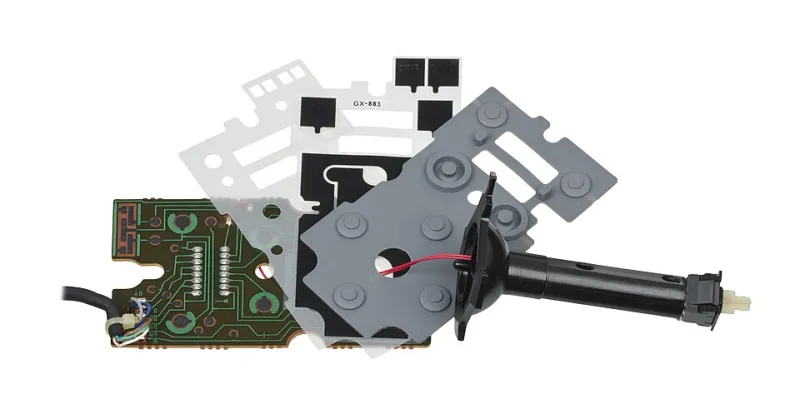
Photo: Evan-Amos, Public domain, via Wikimedia Commons
There's a box in the closet of nearly every serious gamer in America. You know the one. It's stuffed with controllers that technically don't work anymore — a left trigger that spits out inputs like a broken slot machine, an analog stick that drifts so hard it could steer your character off a cliff mid-cutscene, a cracked shell held together with a prayer and a strip of electrical tape. Most people call that box a graveyard. A growing community of beautifully deranged hardware enthusiasts calls it a supply depot.
Welcome to the world of DIY controller modding — a thriving, chaotic, deeply nerdy underground where broken peripherals don't die, they evolve.
The Spark That Started the Fire
Here's the dirty secret gaming companies probably wish you'd forget: modern controllers are not built to last. Joystick drift — the infuriating phenomenon where your thumbstick registers movement you didn't make — has become so widespread it's practically a rite of passage. Nintendo got slapped with class action lawsuits over Joy-Con drift. Xbox controllers have been memed into oblivion for their bumper failures. PlayStation's DualSense, hyped as the second coming of haptic feedback, started showing drift issues within months of launch for some users.
At somewhere around $70 to $80 a pop for a new first-party controller, gamers started doing the math and didn't like the answer. What started as a wave of frustrated YouTube repair tutorials quietly transformed into something far more ambitious: a full-blown hardware hacking subculture with its own heroes, its own techniques, and some absolutely unhinged results.
What Even IS a Frankenstation?
The term "Frankenstation" has been floating around modding forums and Discord servers for a couple of years now, and it refers to any controller that's been so heavily customized, salvaged, and hybridized that it can no longer be traced back to a single original device. We're talking shell swaps between generations, button mechanisms harvested from arcade sticks, triggers ripped from one brand and grafted onto another, circuit boards reprogrammed to remap inputs in ways the manufacturer never intended.
Think of it like a hot rod culture for gaming peripherals. Except instead of a garage in Burbank, it's a folding table covered in soldering irons, isopropyl alcohol, and enough tiny screws to drive a normal person completely insane.
Some of these builds are purely cosmetic — retro shells from '90s consoles fitted with modern internals, translucent cases stuffed with LED strips that pulse in time with in-game audio. Others are deeply functional, built around solving real problems that manufacturers either couldn't or wouldn't address.
Accessibility Mods: Where DIY Gets Genuinely Heroic
Here's where the story takes a turn that might make you feel something, you emotionally stable gamer, you. A significant chunk of the modding community isn't doing this for clout or aesthetics — they're doing it because off-the-shelf controllers simply don't work for their bodies.
Gamers with limited hand mobility, missing fingers, or conditions like cerebral palsy or muscular dystrophy have been quietly building and sharing custom rigs for years. We're talking about controllers with extended triggers that require almost no grip strength, button clusters relocated to the back panel so a player can operate everything with one hand, or foot pedal attachments wired into standard input boards.
Microsoft's Xbox Adaptive Controller gets a lot of well-deserved praise, but it retails for $100 and still requires additional accessories for most users. The DIY community has been filling the gaps Microsoft left behind, building bespoke solutions and sharing the schematics for free on forums and GitHub repositories. It's the kind of thing that makes you feel weirdly optimistic about humanity, right up until you see someone also modded their controller to dispense hot sauce. Because balance.
The Wildest Builds on the Internet Right Now
Okay, let's get into the unhinged stuff, because that's why you're here.
There's a creator on Reddit's r/modcontrollers who built a fully functional Xbox Series X controller out of three separate dead units — the shell from one, the board from another, and the trigger assembly from a third — then 3D-printed custom grips textured to look like alligator skin. It works perfectly. It looks like something a supervillain would use to play Forza Horizon.
Another modder in the fighting game community took a busted DualShock 4, gutted it entirely, and rebuilt the internals into a custom hitbox-style layout — essentially turning a standard gamepad into a hybrid arcade controller that fits in a jacket pocket. The Street Fighter community lost its collective mind.
Then there's the comfort mod scene, which is exactly what it sounds like and somehow even more extra. Extended grips, custom foam padding, palm rests 3D-printed to match individual hand measurements — one modder on TikTok has been documenting a multi-month project to build the "perfect" controller for marathon RPG sessions, complete with a built-in phone mount and a small wrist rest that attaches magnetically. His comment section is split evenly between "this is genius" and "please go outside."
The Parts Economy Nobody Talks About
All this madness has spawned a surprisingly robust secondary market. Sites like iFixit have been stocking controller repair components for years, but now you've got small independent sellers on Etsy and eBay moving specialized components — Hall effect joystick replacements that eliminate drift by design, custom PCBs with expanded remapping capabilities, tactile button kits that give controllers a satisfying clickiness that stock builds never had.
Hall effect sticks in particular have become a kind of holy grail upgrade in the modding world. Unlike traditional potentiometer-based sticks that wear down over time and start drifting, Hall effect sensors use magnets and never physically touch, meaning they theoretically last much, much longer. The fact that you can buy these for around $15 and install them yourself has made a lot of gamers deeply, publicly furious that major manufacturers haven't adopted them as standard. That fury is productive, apparently, because it keeps the mod economy humming.
Planned Obsolescence Accidentally Built a Community
Here's the irony that should keep product managers at Sony, Microsoft, and Nintendo up at night: by making controllers that break predictably and cost a fortune to replace, they accidentally incubated an entire generation of hardware engineers who no longer need them.
The average serious modder has learned soldering, basic electronics, 3D modeling for custom parts, and firmware flashing — skills that translate directly into real-world maker and engineering contexts. Gaming companies tried to create dependency and instead created competency. Beautiful.
The community isn't going anywhere. If anything, it's growing. Every new console generation brings new drift complaints, new flimsy bumpers, new overpriced replacements — and a fresh wave of gamers who decide that if the industry won't build something worth keeping, they'll just build it themselves.
One busted thumbstick at a time, these junk drawer geniuses are quietly proving that the best peripheral ever made might just be the one you build out of three dead ones and sheer stubbornness.
And honestly? Mad Beavers salutes every single one of them.