Plot Holes at the Speed of Light: How Speedrunners Accidentally Rewrote Gaming History
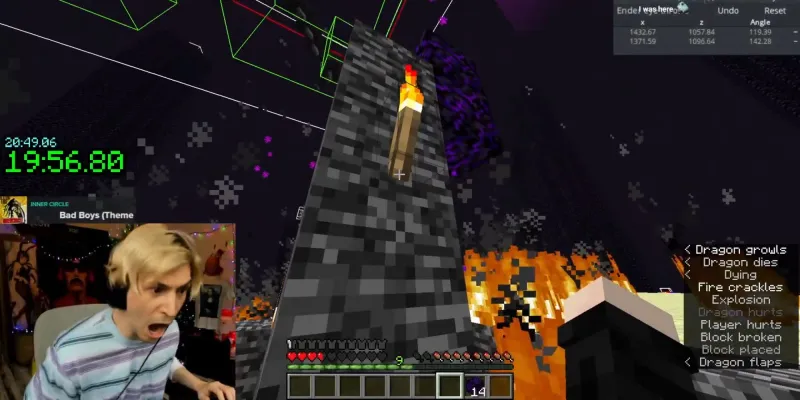
Photo: speedrunner gaming world record timer screen glowing, via static1.thegamerimages.com
There is a particular kind of chaos that only speedrunners can create. It is not the chaos of a griefer, or a troll, or even a modder who decided that horses should explode when startled. No, speedrunner chaos is surgical. It is precise. It is a person spending six hundred hours mastering a game only to reveal, in front of a live audience of forty thousand people, that the entire story makes absolutely no sense.
Developers write lore. Writers craft timelines. World-builders construct elaborate mythologies about why the ancient evil was sealed away and why only the chosen hero can unseal it. And then a speedrunner in a Discord server at 2 a.m. figures out how to clip through the wall of destiny and collect the Sword of Plot Necessity before the game has technically acknowledged it exists.
Congratulations. Canon is broken. Somebody call the writers' room.
The Sequence Break That Asked "But Why, Though?"
Sequence breaking — the art of completing game events out of their intended order — is basically speedrunning's most powerful narrative grenade. When a player is supposed to receive a sacred artifact only after completing three dungeons, earning the trust of an ancient order, and sitting through a twelve-minute cutscene, there is an implied logic: you need those things to proceed. The story depends on it.
Except sometimes you don't. Sometimes you just need a precise jump, a specific frame window, and the complete disregard for everything a game's narrative architecture was built upon.
The Legend of Zelda series has been particularly victimized by this phenomenon. Entire chunks of Hyrule's cosmology rest on the assumption that Link will experience events in a particular order — that he will grow, learn, and be transformed by his journey. Speedrunners have repeatedly demonstrated that Link can, in fact, just not do any of that and still roll credits. Which raises a genuinely uncomfortable question: if the Triforce of Courage can be obtained before Link has done a single courageous thing, does the Triforce of Courage just have terrible judgment? Fans have written essays. Actual essays. The lore community remains divided.
When Developers Had to Do Damage Control for a Glitch
Sometimes the collision between speedrunning and storytelling gets loud enough that the people who made the game have to publicly address it, which is a deeply funny situation to watch unfold.
Imagine spending years building a fictional world, hiring voice actors, commissioning concept art, and then having to go on a podcast or a Reddit AMA to explain why a player can technically complete your game's entire first act without ever meeting the character whose death is supposed to motivate the whole plot. That is not a hypothetical. That has happened. Developers have sat in interviews and, with the strained patience of someone explaining why the dog cannot drive the car, walked through why the glitch that lets you skip the emotional core of their narrative does not, technically, mean the emotional core never happened.
The community's response to these explanations is typically a mixture of genuine philosophical engagement and barely concealed glee. Nothing quite captures the internet's spirit like watching a developer say "well, canonically, the events still occurred" while a speedrunner's world record run sits in a YouTube tab with 800,000 views showing that they very much did not.
The Fan Theory Pipeline: From Exploit to Alternate Timeline
Here is where things get genuinely, beautifully unhinged. When speedrunning exploits create narrative contradictions, fan communities do not simply shrug and move on. They build on it. They construct elaborate alternate timeline theories. They write wiki articles with headers like "The Sequence Break Timeline" and "Canon Implications of the Early Ending Skip." They treat a collision detection error as though it were a deliberate authorial choice rich with thematic meaning.
This is not mockery. This is admiration. The speedrunning community and the lore community represent two completely different relationships with the same piece of media, and when they collide, the resulting fan content is frequently more creative than anything the developers originally intended. Some games have entire secondary mythologies now — shadow canons, if you will — built entirely on the foundation of what happens narratively if you accept that the speedrun is the true playthrough.
Metroid is a franchise that has suffered and benefited from this in equal measure. Samus's timeline is already famously complicated enough to require a flowchart, and speedrunners have added approximately seventeen new branches to that flowchart by finding ways to experience game events in orders that the timeline explicitly says are impossible. The response from dedicated lore analysts has been less "this breaks everything" and more "okay but what if this is a parallel Samus from a branching quantum instance" — which, honestly, is a more interesting answer.
The Developers Who Leaned Into the Chaos
Not every studio responds to speedrunning-induced narrative destruction with damage control. Some of them, bless their chaotic little hearts, just lean in.
There is a growing tradition of developers quietly acknowledging speedrunning culture in subsequent games — hiding jokes for runners, building in references to famous exploits, or even, in a few remarkable cases, incorporating the "broken" version of events into expanded lore in ways that make the exploit feel intentional. It is a form of retroactive canonization that would have seemed absurd twenty years ago but now feels like a natural part of how games exist as living, community-shaped things.
When a developer winks at a sequence break in a sequel, they are essentially saying: we saw what you did, we cannot stop you, and frankly we respect it. That is a relationship between creator and audience that no other medium quite replicates. Books do not update their plot to reflect speed-readers. Films do not add post-credits scenes acknowledging that someone watched them at 2x speed. Games, increasingly, do.
Canon Is a Suggestion, Apparently
What speedrunning has revealed, more than anything, is that game narratives are fundamentally more fragile and more flexible than their creators often intend. A story that can be structurally demolished by finding the right pixel to stand on was always, in some sense, a story held together with good faith rather than iron logic.
That is not a criticism. It is a feature. The fact that players can find these cracks, exploit them spectacularly, and then watch entire communities build new meaning out of the wreckage is one of the genuinely strange and wonderful things about games as an art form.
Speedrunners did not set out to break canon. They set out to break records. The lore just got in the way, and now we have forty-page fan documents theorizing about the metaphysical implications of skipping a cutscene.
The beavers respect the grind. Chew through the wall. See what falls apart.